LLM quantization: how much quality does one bit cost
Quantization is the cheapest way to speed up inference, but the “free cheese” ends at Q4. We ran three open models (7B, 13B, 34B) through a task suite and pinpointed where degradation actually begins.
Methodology
- Formats: GGUF (llama.cpp, Q4_K_M, Q5_K_M, Q8_0 quants) and AWQ 4-bit (vLLM);
- Metrics: perplexity on an English corpus, fact-extraction accuracy from documents, P95 latency, peak memory;
- Hardware: RTX 4090 24 GB and an ARM SBC with RK3588.
Results
| Config | Perplexity (Δ vs FP16) | Speed | Memory |
|---|---|---|---|
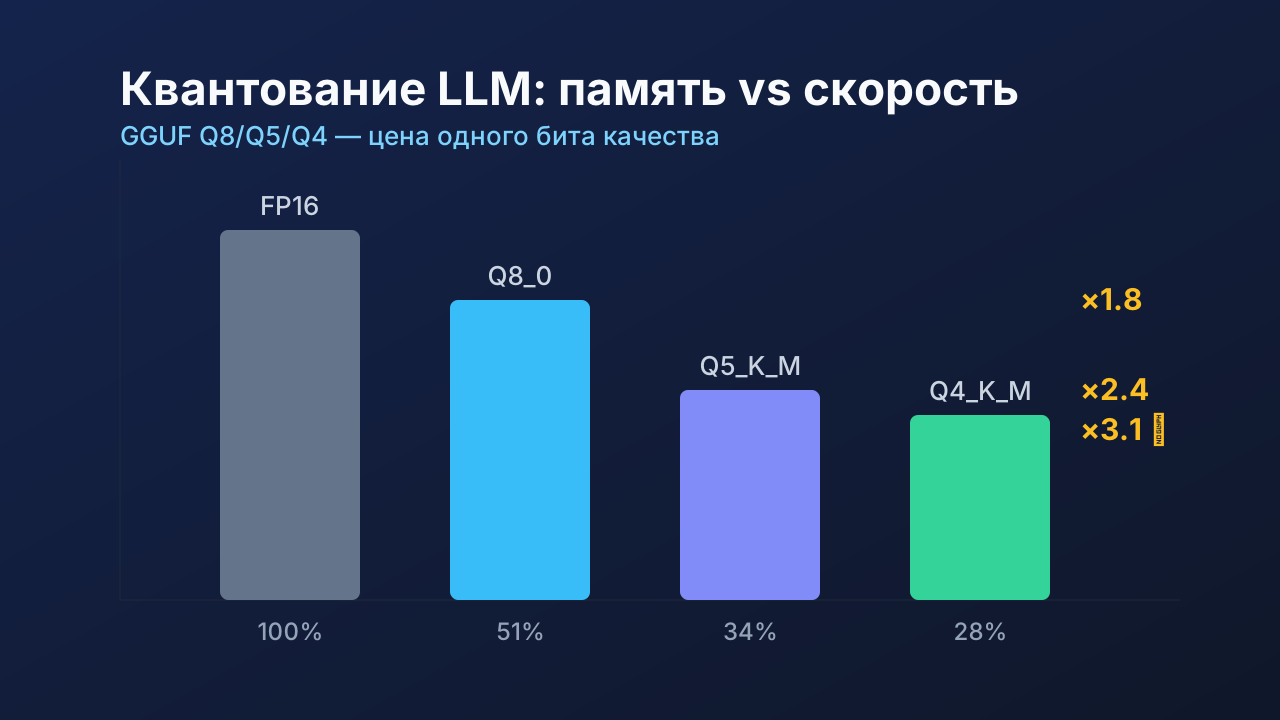
| Q8_0 | +0.1% | ×1.8 | 51% |
| Q5_K_M | +0.4% | ×2.4 | 34% |
| Q4_K_M | +1.9% | ×3.1 | 28% |
| AWQ 4-bit | +1.2% | ×4.2 (batch) | 27% |
Practical takeaway: Q5_K_M is the sweet spot — quality is nearly indistinguishable from Q8 while the memory savings are already there. Q4_K_M is already noticeably worse at fact extraction (−4…7 p.p. on narrow domains) but works great for chat tasks. For RAG with citations we do not recommend going below Q5 — source links start to drift.
Next time
Distillation: when it is cheaper to train a 7B student to the level of a 34B teacher once than to keep serving the quantized teacher.